Baldr was found. That is the unsettling fact at the heart of the attempt to bring him back from death. Hermóðr crossed the dark valleys, passed the guardian of a golden bridge, and entered the hall where Baldr sat in a place of honour. The journey succeeded. The rescue did not.
In Snorri Sturluson’s account of Hermóðr’s mission, the obstacle is not an unbeatable monster or an impossible road. Hel offers a condition: everything in the world must weep for Baldr. Almost everything does. One figure in a cave refuses, and that refusal is enough.
The story belongs to a particular medieval text
The detailed rescue attempt comes from Gylfaginning, part of Snorri’s thirteenth-century Icelandic Prose Edda. It should not be treated as a transcript of a single, universally shared Viking belief. We are reading a medieval literary account that arranges inherited mythological material into a connected narrative.
The distinction matters because the Eddic poem Völuspá also tells of Baldr’s death and eventual return, but not through the same sustained sequence of journey, negotiation, and failed appeal. Judith Woolf’s translation and commentary on Völuspá help distinguish the poem’s compressed visions from Snorri’s fuller storytelling. The witnesses illuminate each other without becoming interchangeable.
For this question, Snorri supplies the decisive episode. His account asks readers to imagine not merely whether someone can reach the dead, but whether reaching them gives the living any power to reverse their loss. The answer unfolds in stages: a difficult journey, a surprisingly recognisable reunion, and a condition whose smallest exception destroys the hope it offers.
A road that can be travelled, but not conquered
According to the Old Norse text and Brodeur translation presented by the University of Oslo, Hermóðr rides for nine nights through valleys so dark and deep that he sees nothing until he reaches the river Gjöll. Its bridge is covered with shining gold, and a maiden named Móðguðr guards the crossing.
She recognises something unusual about him. Five companies of dead people crossed the previous day, yet the bridge makes no less noise beneath this single rider. His appearance also differs from theirs. Hermóðr is travelling the road of the dead without being one of its ordinary travellers.
Móðguðr does not attack him. She asks his identity and purpose, then confirms that Baldr has passed that way. The road continues downward and northward. The scene makes the boundary between living and dead perceptible through sound, appearance, and direction rather than through a battle.
At Hel’s gate, Hermóðr dismounts, tightens his horse’s girth, remounts, and spurs the animal into a leap that clears the barrier. That practical adjustment is a memorable detail: before the extraordinary jump comes the ordinary care of a rider preparing his mount. Yet getting over the gate does not mean defeating the authority within. Movement through a realm and power over its inhabitants are different things.
Baldr can send gifts, but cannot simply leave
Inside the hall, Hermóðr finds Baldr seated in the high-seat and stays overnight. In the morning, he asks Hel to let Baldr ride home with him, explaining the grief among the Æsir. These events appear together in the parallel-text account of the visit.
The reunion is strikingly restrained. Baldr is not shown struggling against chains or begging for escape. He receives a visitor, spends time with him, and later accompanies him out of the hall. The scene permits affection and recognition across death’s boundary without making that boundary disappear.
Baldr sends the ring Draupnir back to Odin as a remembrance. Nanna sends gifts too: linen for Frigg and a finger-ring for Fulla. Objects can return to the gods even when the people sending them cannot. Read as storytelling, those gifts make the separation more painful rather than less real. Hermóðr brings tangible evidence of contact, but not the person everyone wants restored.
Hel answers his request by proposing a test of Baldr’s supposed universal belovedness. Every thing must mourn him, living and nonliving alike. If any refuses or objects, Baldr remains with her. This is not a promise that sufficient grief will outweigh resistance. It requires agreement without exception.
Why stones and trees must weep
When Hermóðr reports back, the gods send messengers throughout the world. People, animals, earth, stones, trees, and metals respond. Snorri connects their tears to a familiar observation: such things appear to weep when brought from frost into warmth. The Cambridge presentation of the passage preserves this movement between cosmic mourning and an everyday physical image.
It is an effective way to make an immense claim imaginable. Readers need not picture every stone acquiring a human face. Moisture on a cold surface supplies an image for the grief of things that have neither voices nor eyes.
There is also a revealing change in the kind of task being attempted. Hermóðr’s ride depends on determination and the ability to pass obstacles. The messengers’ mission depends on willing participation. No leap, however impressive, can substitute for another being’s consent.
That concern with the limits of divine security offers a useful connection to why Fenrir demanded Týr’s hand. The stories should not be collapsed into one lesson, but both invite attention to conditions that the gods cannot simply brush aside. Here, the decisive condition is not strength or courage. It is unanimity.
The dry-eyed figure in the cave
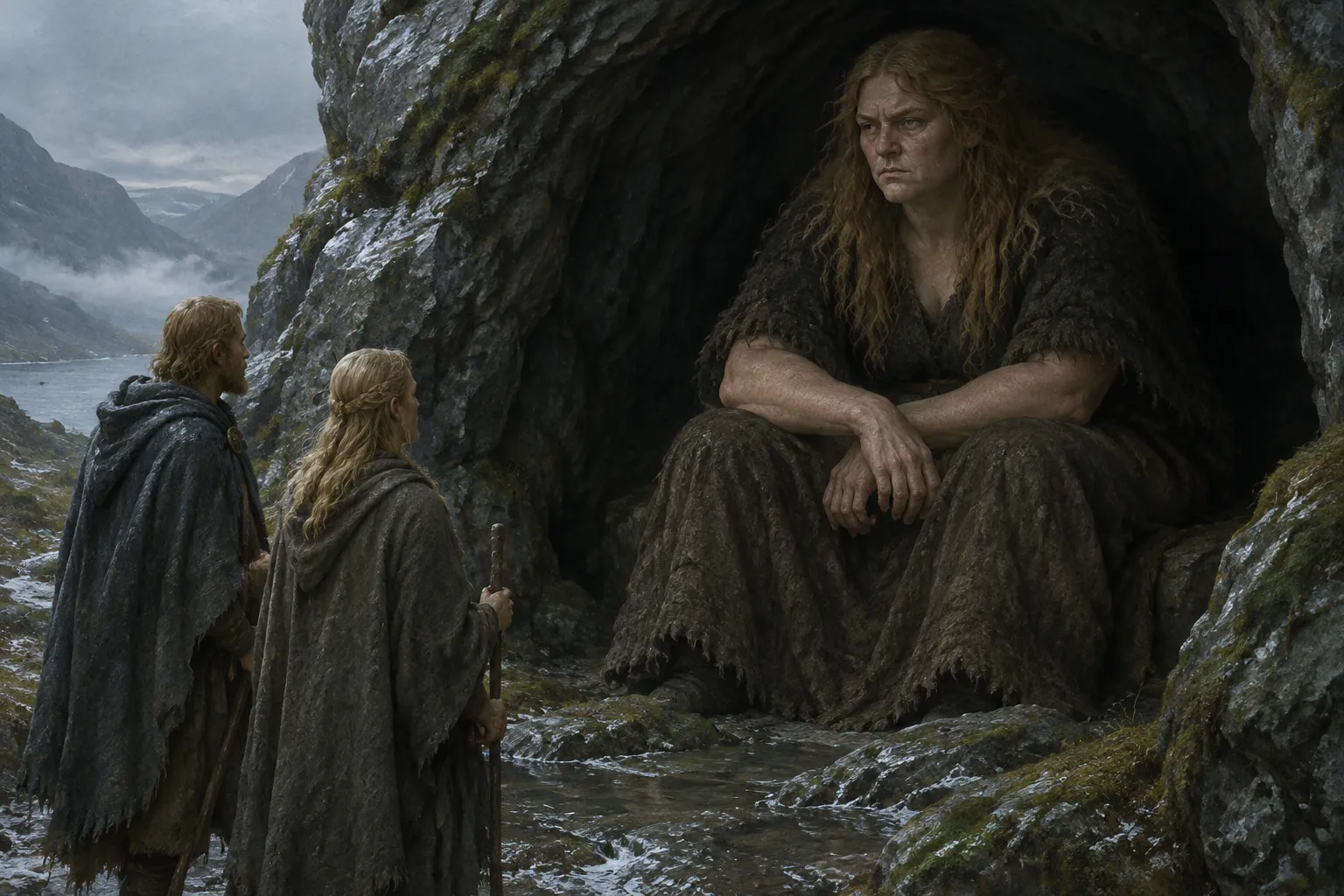
The messengers are returning after apparently fulfilling their errand when they encounter a giantess sitting in a cave. She calls herself Thökk, also written Þökk. Asked to mourn Baldr, she answers with the opposite of the tears they need. In Brodeur’s translation of her verse, her tears are waterless, and she insists that Hel should retain what she possesses.
The placement of the encounter gives it particular force. The great journey has already been completed. The world has already answered. What defeats the mission is a brief refusal near its apparent conclusion.
Her answer also rejects the premise behind the appeal. The messengers approach her on the assumption that Baldr deserves everyone’s grief. She speaks instead from her own claimed lack of attachment to him. Whatever readers make of that position, Hel’s condition has given one dissenting voice decisive power.
Was Thökk Loki? The narrative points strongly in that direction, but its wording preserves a qualification. The Faulkes translation reproduced by Cambridge presents the identification as something presumed, rather than describing a transformation witnessed by the messengers. A careful retelling should preserve that distinction: Loki is the suggested identity, not an unmasked figure within this scene.
Nor does the failed mission mean that Baldr must remain absent forever. The later vision in Völuspá places Baldr and Höðr together in the renewed world, as discussed in Woolf’s commentary on the poem’s closing movement. That future return is different from coming home with Hermóðr. The immediate rescue fails because its condition is unmet; the later renewal belongs to a world beyond the catastrophe of Ragnarök.
The cave scene therefore ends one hope, not every possible future. Hermóðr proves that Baldr can be reached. Thökk’s refusal proves that reaching him is not enough.
Sources and further reading
- University of Oslo: Hermóðr’s attempt to recover Baldr — Old Norse with Arthur Gilchrist Brodeur’s 1916 English translation and a Norwegian translation.
- University of Cambridge: Hermóðr’s ride — Old Norse text and Anthony Faulkes’s English translation, with edition references.
- Judith Woolf, The Spaewife’s Prophecy — a 2017 translation of Völuspá with commentary distinguishing its visions from Snorri’s narrative.


