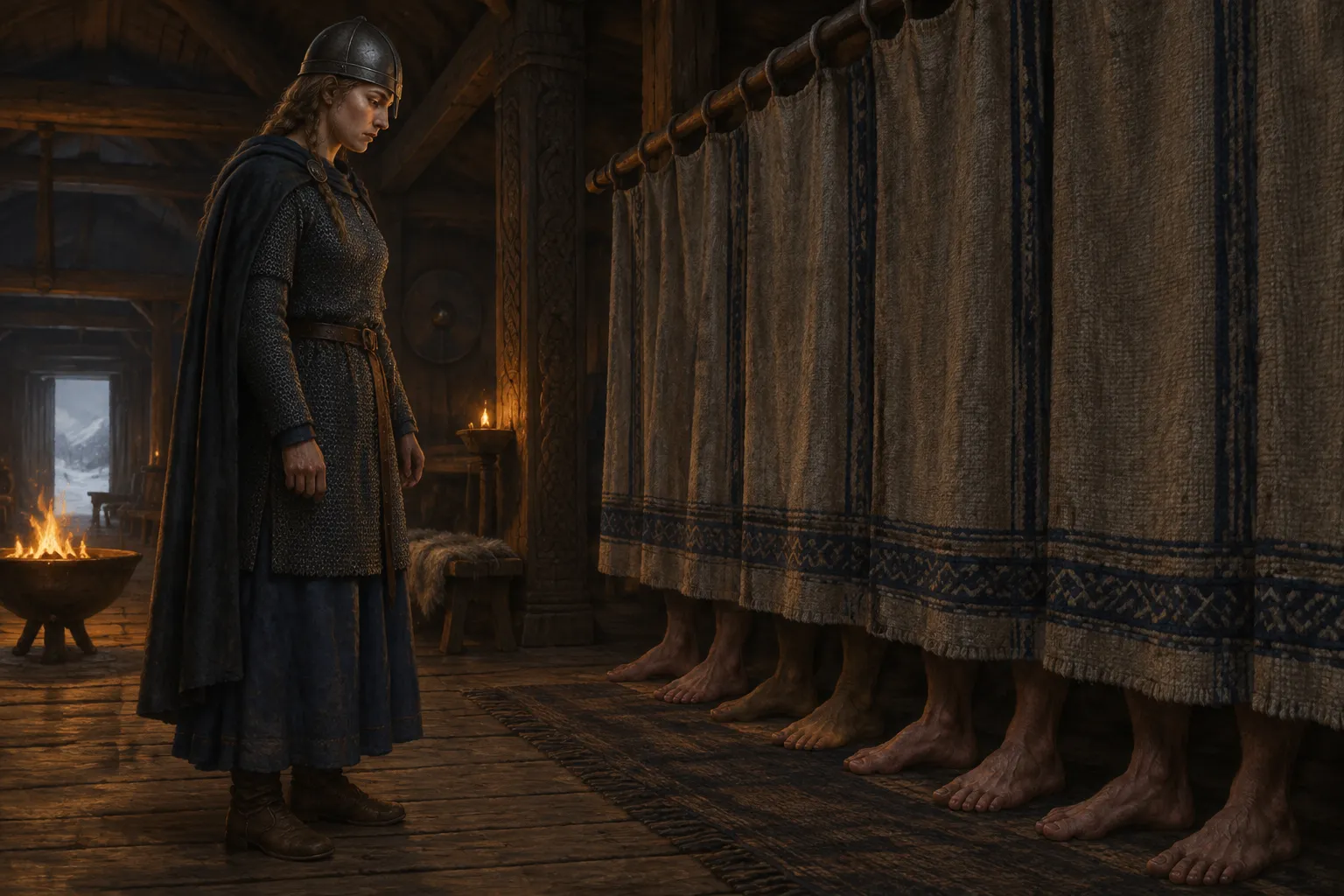
Skadi does not arrive in Asgard looking for love. She arrives armed, demanding an answer for her father’s death. Yet the confrontation becomes a marriage negotiation with a peculiar restriction: she may choose a husband, but she may see only his feet. The beautiful pair she selects belongs not to Baldr, as she expects, but to Njord. That is the turn preserved in the Prose Edda’s account of her compensation.
Read as a romantic mishap, the episode can seem like a joke about a mistaken choice. Read from Skadi’s entrance onward, it asks a more interesting question: what can a negotiated settlement repair, and what remains beyond its reach? Marriage may end an immediate confrontation without making two people want the same life.
1. An armed daughter, not a waiting bride
In the narrative translated by Rasmus B. Anderson under the heading How Njord got Skade to Wife, Skadi puts on helmet, mail and war gear before confronting the gods. They offer compensation. Her marriage choice is one part of that settlement, not an independent courtship. The surrounding story concerns the death of her father, Thjazi, following the recovery of Idunn.
For that earlier crisis, see our account of why the gods grow old without Idunn. Here, the focus shifts from rescuing the goddess to dealing with the bereaved daughter of the gods’ enemy.
This change of viewpoint matters. A rescue can look complete from the rescuers’ side while leaving an unresolved grievance elsewhere. Skadi’s entrance prevents the reader from treating the preceding victory as an uncomplicated ending. Someone still has a claim to press.
That is a literary reading, not proof that this scene records an actual marriage custom or a historical compensation hearing. Its usefulness lies in following the story’s own sequence: threat, negotiation and an attempt to establish a different relationship.
2. What choosing by the feet actually means
The restriction gives Skadi a choice while withholding the information needed to make it confidently. In Anderson’s translation of the husband-selection scene, she chooses exceptionally attractive feet because she believes they must belong to Baldr; they belong to Njord instead.
The distinction between choosing and choosing knowingly is the scene’s sharpest feature. Skadi acts, judges and announces her decision. Yet the terms of the offer prevent her from identifying the person she wants. Agency and constraint occupy the same moment.
It would be tempting to supply an explanation for Njord’s attractive feet, or to turn the selection into an established ritual with a symbolic meaning. The passage itself does not require either move. Its immediate mechanism is simple: a beautiful visible part leads Skadi to an incorrect conclusion about the concealed whole.
Nor should the episode automatically become a moral lesson about female vanity. That reading would overlook who designed the restriction. The gods offer a settlement whose rules make mistaken recognition possible. The resulting comedy need not erase the imbalance built into the arrangement.
3. The father’s house remains on the map
A different textual witness offers a quieter but important perspective. In Grimnismal, stanza 11, Thrymheim is identified first with Thjazi and then with Skadi, who now occupies her father’s former home. She is simultaneously described as a divine bride. Stanza 16 separately names Noatun as Njord’s dwelling.
These are entries in a poem’s catalogue of divine places, not a retelling of the feet-selection episode. The distinction matters: a brief statement about residence cannot supply every event in a marriage story. It can, however, stop us assuming that marriage simply removes Skadi from her father’s world.
Read alongside the prose narrative, the two named homes suggest a useful contrast. A settlement creates a new connection; a home preserves an older one. Neither has to vanish merely because the other exists.
The poem’s economy is striking. It does not need to dramatize an argument in order to give Skadi a continuing location of her own. Her father’s house is not merely background scenery for his death. In this witness, it is also her present dwelling.
That does not establish a universal rule about inheritance among Norse women or giantesses. It establishes something narrower and more secure: the poem associates this named woman with this named paternal home. The narrow claim is enough to enrich the story.
4. A household neither spouse can enjoy
Elsewhere in the Prose Edda’s account of Njord and Skadi, their incompatible preferences become a problem of residence. He dislikes the mountains and their wolves; she cannot sleep beside the sea because of the birds. Skadi returns to Thrymheim, where the text associates her with skiing and hunting.
The domestic difficulty is wonderfully concrete. The problem is not an abstract opposition announced by a narrator. It is the sound that keeps someone awake, the surroundings that make another person miserable. A place that feels right to one spouse is intolerable to the other.
We can read this as the limit of their negotiated alliance. The agreement can determine a marriage partner, but it cannot dictate comfort, attachment or belonging. A successful bargain and a successful shared household are different achievements.
Calling the outcome a modern divorce would go beyond what these passages establish. Equally, presenting their marriage as an uncomplicated happy ending would flatten the evidence. The more careful description is that the prose portrays a failed attempt to share preferred surroundings, while the poem places Skadi in her father’s home.
5. Another poem refuses an easy reconciliation
Skadi is also present in Lokasenna’s introductory prose, which identifies her as Njord’s wife among the guests at Aegir’s feast. Later, in stanzas 49–52, she and Loki exchange threats and accusations. Loki boasts about his involvement in Thjazi’s death; Skadi answers with hostility. The concluding prose gives her a role in fastening the venomous snake above the captive Loki.
This witness should not be forced into a seamless sequel with every detail of the Prose Edda’s settlement. Lokasenna is an insult contest, and its speakers are trying to wound one another. Loki’s further sexual allegation against Skadi belongs to that hostile setting; it is not neutral biographical narration.
Still, the exchange offers a powerful alternative emphasis. Skadi’s connection with the gods does not make her father’s death emotionally irrelevant. Her status as a wife and her anger as a daughter can coexist.
That is why the feet episode rewards reading beyond its punchline. The medieval Icelandic Eddic witnesses do not give us one smooth romance: they offer a negotiated marriage, separate attachments to place, and a grievance voiced again in another literary setting. The most compelling question is not simply why Skadi chose the wrong feet. It is why anyone should expect a marriage bargain to settle everything those feet would carry into the household.
Sources and further reading
- The Younger Edda, translated by Rasmus B. Anderson: the husband-selection narrative and the account of the couple’s incompatible homes. This historical translation uses spellings such as Skade and Njord.
- Grimnismal, translated by Henry Adams Bellows: especially stanzas 11 and 16. Distinguish the translated verses from Bellows’s explanatory notes.
- Lokasenna, translated by Henry Adams Bellows: introductory prose, stanzas 49–52 and concluding prose; these are distinct components of the transmitted text.


