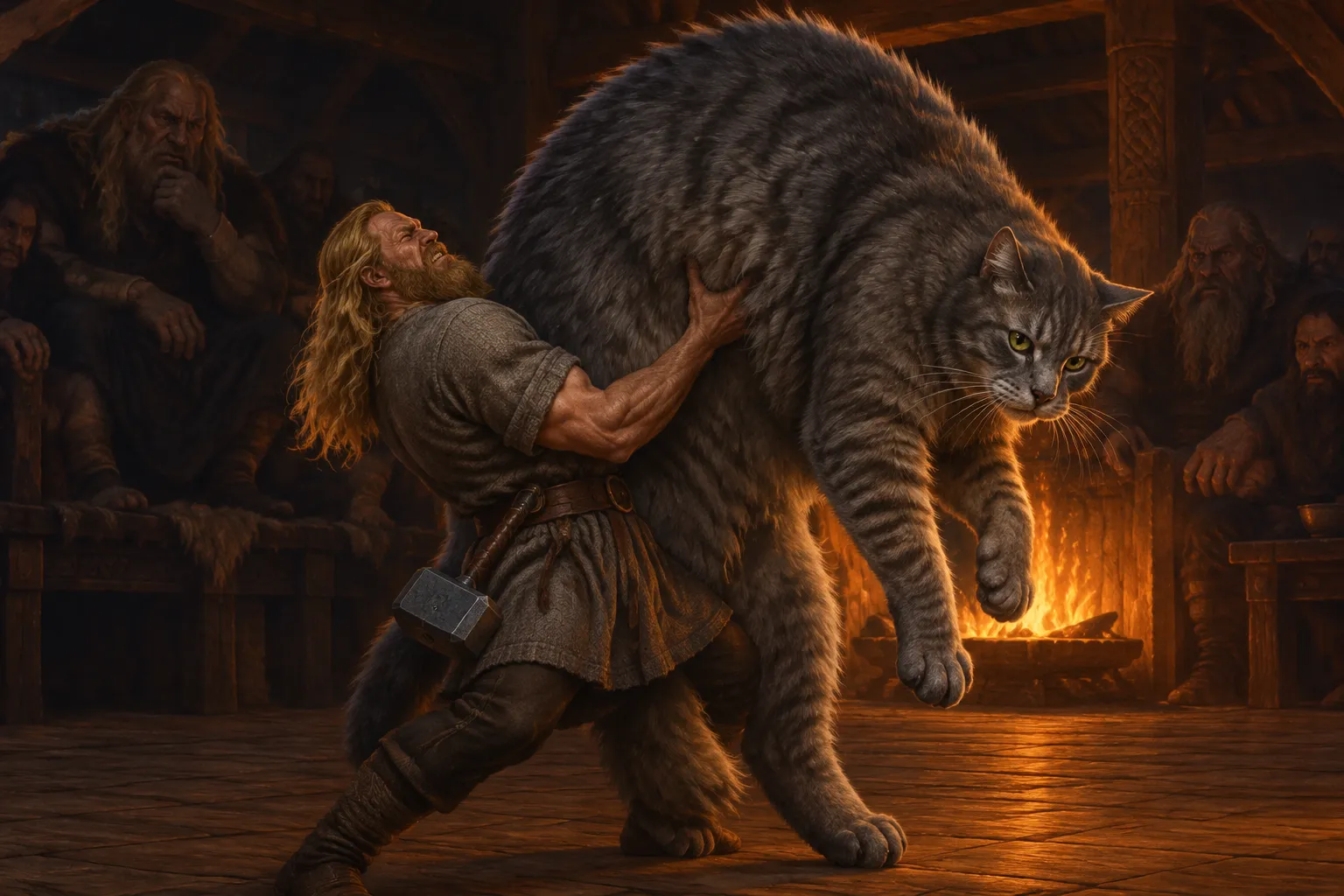
Thor slides a hand beneath a gray cat’s belly and lifts. The animal arches its back. Thor stretches higher, pushing his strength to its limit, until a single paw finally leaves the floor. That is all he can manage.
His host treats the result as another embarrassment. Only the next morning does Thor learn what he has actually held: the Midgard Serpent, the creature encircling the world. The spectators were not merely watching a failed party trick. They were frightened by how much he had moved it.
In Gylfaginning, chapters 46–47, the answer to why Thor cannot lift the cat changes the meaning of the entire contest. He has not suddenly become weak. He has been denied the knowledge needed to understand his own strength.
A challenge designed to look beneath him
The continuous account appears in Gylfaginning, part of the medieval Icelandic Prose Edda associated with Snorri Sturluson. Here we follow Arthur Gilchrist Brodeur’s translation. Two Eddic poems offer related allusions, but neither of the passages examined below tells the cat episode. Keeping these witnesses separate matters: a brief poetic insult is not another complete version of Snorri’s narrative.
In chapter 46’s arrival at Útgarðr, Thor and his companions enter a stronghold so enormous that they can squeeze between the bars of its closed gate. Inside, Útgarða-Loki mocks their small appearance and insists that visitors demonstrate an exceptional skill. He is the host and organizer of the contests, distinct from Loki, who has arrived with Thor.
The challenges quickly become humiliating. Loki competes at eating and loses to Logi, who consumes not only the meat but also its bones and the trough. Thor’s swift companion Thjálfi loses a footrace against Hugi. Thor then takes three immense drinks from a horn without emptying it.
Only after this does Útgarða-Loki introduce the cat. He presents lifting it as something young boys do, a small accomplishment that ought scarcely to merit Thor’s attention. The insult is carefully placed. Thor has already failed at something he chose himself; now he must attempt something his host describes as almost trivial.
The detail that makes the cat impossible
The description of the lifting attempt is unusually physical. The cat is gray and very large. Thor puts his hand beneath its middle, rather than seizing it by the neck or tail. As his hands rise, its back arches, apparently absorbing the upward movement. At his greatest reach, one foot comes clear.
That detail gives the episode its comic precision. Thor does not simply announce that the animal is too heavy. He appears to make progress, yet the expected result keeps escaping him. His movement and the cat’s movement fail to produce the ordinary consequence: an animal lifted from the ground.
Útgarða-Loki supplies a convenient explanation. The cat is large, he says, and Thor is small compared with the people of the hall. Within the scene, this sounds plausible because everything has already been presented on an overwhelming scale.
But the following morning’s revelation overturns that explanation. According to Útgarða-Loki’s account in chapter 47, the cat was the Midgard Serpent, whose length stretches around the inhabited world. Thor had raised it so high that it came close to heaven. Everyone who saw the lifted foot had reason to be afraid.
The narrative identifies the creature with the serpent, not merely with an unusually heavy animal. It does not explain the mechanics of the deception. We should therefore resist turning the scene into an exact system of magical transformation. What the story makes clear is the mismatch between the object Thor perceives and the being against which his strength is measured.
Why the other contests explain the cat
The cat belongs to a sequence of concealed opponents. In the host’s explanation of the games, Logi is wildfire, which naturally consumes the wooden trough along with its contents. Hugi is Útgarða-Loki’s thought, something a runner cannot be expected to outrun. The far end of Thor’s drinking horn reaches into the sea.
These revelations do more than excuse the visitors. They change the scale of what happened. Thor’s drinking has lowered the sea, an effect the tale connects with ebb tides. His failure to empty a vessel becomes an extraordinary action upon the surrounding world.
After the cat, Thor demands a wrestling opponent. Útgarða-Loki brings out his aged nurse, Elli, who eventually forces him onto one knee. She too conceals something larger than her appearance: she is Old Age. The host expresses wonder that Thor resisted her so long, since age eventually brings down everyone who lives to encounter it.
This is not the same episode as the gods growing old without Idunn. Here aging appears as a personified wrestling opponent within a deceptive contest. The connection is useful precisely because the stories imagine divine vulnerability differently.
Read together, the games suggest an interpretation rather than a rule explicitly stated by the narrator: Útgarða-Loki wins by controlling the comparison. A drinking horn, a household cat, and an elderly woman sound manageable. The sea, the world-encircling serpent, and old age do not.
What the poems actually preserve
The poetic witnesses help establish that Thor’s embarrassing journey had a life beyond this continuous prose telling. They also warn against treating every surviving reference as identical.
In Lokasenna, stanza 62, Loki answers Thor’s threats by recalling Skrýmir’s provision bag. Thor could not get at the food because he could not undo its straps. In Gylfaginning, this belongs to the journey before the hall contests: the travelers meet the enormous Skrýmir, and Thor repeatedly strikes him with his hammer after failing to open the bag.
The poetic stanza supplies a pointed recollection, not the later explanation of the cat. Its immediate purpose is ridicule. Loki uses a remembered failure to puncture Thor’s threatening display. The distinction between that stanza and the accompanying modern translator’s explanatory note is important: the note retells more of the adventure than the verse itself contains.
In Hárbarðsljóð, stanza 26, Hárbarðr mocks Thor for taking shelter in a glove and being too frightened to make a noise. The passage names Fjalar. By contrast, Gylfaginning names the giant whose glove provides shelter as Skrýmir, and later identifies him with Útgarða-Loki.
Bellows’s accompanying note proposes confusion among names as an explanation. That is an editorial interpretation, not something the stanza proves. The secure observation is narrower: the poem invokes the glove humiliation with a different name. It does not independently recount the cat’s concealed identity.
A failure that frightened the winner
When Útgarða-Loki finally explains himself, he admits that Thor’s strength had placed the household in danger. Even the earlier hammer blows had been formidable: he says he secretly interposed a mountain, leaving valleys where Thor believed he had struck Skrýmir. The supposedly insignificant visitor has been powerful throughout. His host has concealed the evidence.
Yet the ending of chapter 47 does not give Thor a straightforward victory. He raises his hammer, but Útgarða-Loki disappears. Thor turns toward the stronghold, intending to destroy it, and finds only an open plain. Knowledge arrives too late to let him confront the organizer on equal terms.
The narrator then connects the journey with Thor’s determination to encounter the Midgard Serpent again. The cat is therefore more than a comic interruption: it helps direct the story toward another confrontation with the same immense adversary.
Why could Thor not lift Útgarða-Loki’s cat? Because there was no ordinary cat to lift. But the sharper point is that raising one paw was already astonishing. The host called it failure while concealing the scale of the achievement—and the fear it had caused.
Sources and further reading
- Gylfaginning, chapters 41–50, translated by Arthur Gilchrist Brodeur; especially chapters 44–47 for the journey and contests.
- Lokasenna, stanzas 61–65, translated by Henry Adams Bellows; stanza 62 recalls Skrýmir’s provision bag.
- Hárbarðsljóð, stanzas 26–30, translated by Henry Adams Bellows; stanza 26 supplies the glove allusion and the name Fjalar.


