
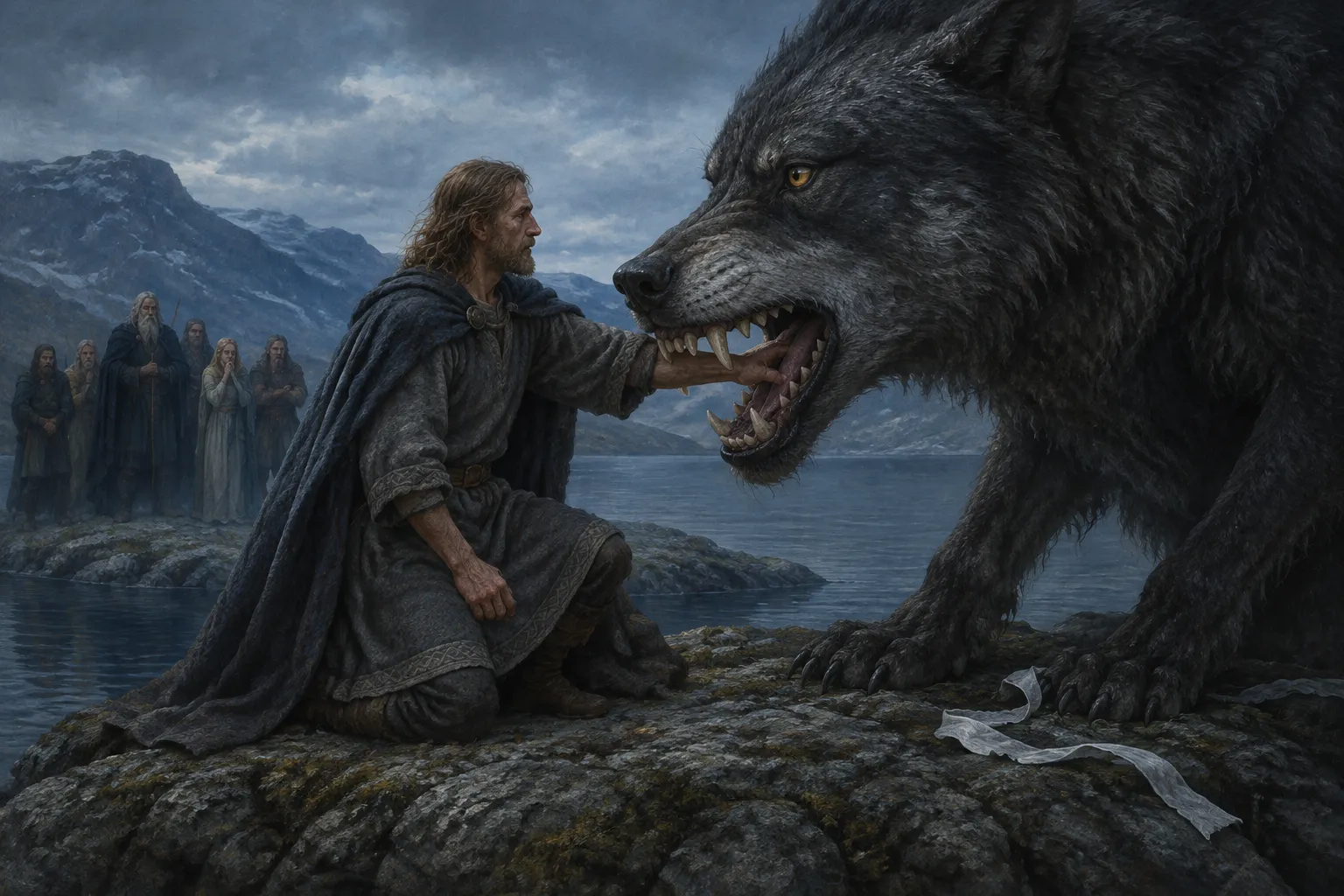
Fenrir does not fall for the ribbon because he mistakes it for something harmless. He suspects exactly the opposite. The wolf has already broken two formidable fetters; now the gods offer him a slender band and another chance to prove his strength. He notices that the challenge makes little sense. Breaking something so slight would bring little glory. Failing might mean never getting free.
His answer changes the encounter from a strength contest into a test of trust: one of the gods must put a hand inside his mouth. In Snorri Sturluson’s Gylfaginning, chapter 34, Týr supplies his right hand. The pledge is the missing part of the trap—not because Fenrir believes the gods, but because he wants their assurance to carry a cost.
A feared future, not a recorded attack
The detailed account belongs to Gylfaginning, part of Snorri’s thirteenth-century Prose Edda. It is a medieval literary witness to Norse myth, rather than a contemporary report of Viking-Age belief or practice. Its explanations unfold through questions asked by Gangleri and answers supplied by the figure called Hárr, or High. Keeping that storytelling frame in view matters: the narrative itself anticipates several questions readers are likely to ask.
In chapter 34 of Brodeur’s translation, Fenrir is one of three children born to Loki and the giantess Angrboða. His siblings are the great serpent Jörmungandr and Hel. The gods learn through prophecy that these children will bring them disaster, and their ancestry deepens the gods’ suspicion. Odin has them brought before him and assigns them very different places.
Fenrir remains among the gods, growing alarmingly. Týr alone dares approach him with food. That detail gives their eventual encounter particular force, but it should not be expanded into an unwritten childhood friendship. Snorri says Týr feeds the wolf and emphasizes his courage; he does not describe affectionate conversations, adoption, or a promise of lifelong protection.
Nor does this episode begin with Fenrir attacking the gods. Their decision to restrain him follows his growth and the prophecies. Readers may therefore see a troubling problem of preventive imprisonment. That is an interpretation of the narrative’s arrangement, not an explicit declaration that Snorri regards the wolf as innocent or the gods as unjust.
How two victories prepare the third test
The first fetter is Læðingr. The gods invite Fenrir to test himself against it, and he agrees because he considers the task manageable. His first effort breaks it. They then make Drómi, a stronger restraint, and repeat the challenge with a more pointed appeal to reputation: escaping such workmanship would establish his extraordinary strength.
Fenrir recognizes the greater risk but also knows that he has grown stronger. He accepts, struggles, and scatters the broken pieces. In the account of these two trials, the wolf is capable of weighing danger against fame. His willingness is not simply mindless animal aggression.
These victories establish the terms of the third encounter. The gods have taught Fenrir to understand binding as a public demonstration of strength. They have also learned that stronger conventional restraints are not enough. Their next solution must change the nature of the contest while preserving enough of its familiar appearance to secure his participation.
Notice, too, who makes the first two fetters: the narrative attributes them collectively to the Æsir. It does not single out Thor as their smith. The crucial contrast is between the gods’ unsuccessful workmanship and the extraordinary craft they subsequently commission.
Gleipnir looks too small to trust
Odin sends Skírnir, Freyr’s messenger, to dwarves in Svartálfaheimr. They produce Gleipnir, a restraint that feels smooth and soft like a silk ribbon. Its ingredients belong to a different order from ordinary metalwork: a cat’s footfall, a woman’s beard, roots of rock, bear sinews, fish breath, and bird spittle, in Brodeur’s wording.
The Old Norse text presented beside an English translation makes the contrast especially clear: the fetter is soft as a silk strip, yet astonishingly strong. This is a description of its appearance and feel, not a statement that the dwarves weave it from ordinary silk.
Hárr pauses the story to argue playfully from familiar absences: cats move without the expected noise, women lack beards, and rocks have no roots. Those observations supposedly confirm the strange materials. This is the narrator’s mythic reasoning, not a recipe readers could reconstruct or a historical account of binding magic.
The gods take Fenrir to the island Lyngvi in the lake Ámsvartnir. They pass the band among themselves and pull at it without breaking it. Yet they assure the wolf that he will succeed. Fenrir now sees the difficulty: an apparently trivial object may conceal precisely the craft that makes escape impossible. His suspicion is well founded within Snorri’s description of Gleipnir and the island challenge.
The promise behind the hand
The gods offer an argument designed to sound reassuring. If Fenrir cannot break such a slight band, they say, he cannot be dangerous to them; therefore they will release him. He answers that, once they have him helpless, their help will probably be slow to arrive. He nevertheless wants to avoid being accused of cowardice.
His demand is consequently specific. A god must place a hand in his mouth as security that the test involves no deceit. The hand is not an agreed payment that purchases his captivity. It guarantees the good faith of an arrangement that includes the promise of release. That distinction is central to the exchange immediately before Týr acts.
The gods look at one another. None volunteers until Týr extends his right hand. Fenrir struggles, but this time resistance makes the restraint tighter. The others laugh; Týr does not. He loses his hand. An earlier notice about Týr in chapter 25 states the broken assurance even more directly: the wolf bites when the gods refuse to free him.
Týr’s courage and the gods’ deception therefore coexist. Calling his act a sacrifice can describe its terrible personal cost, but it should not erase the pledge’s purpose. He enables the gods to obtain Fenrir’s consent to a test whose promised outcome they will not honor. The text makes the act brave without making the transaction trustworthy.
This is not the only story in which divine safety rests on something precarious. The site’s account of why the gods grow old without Idunn explores a different vulnerability: their dependence on someone whose absence they cannot simply overcome by force.
A binding that postpones the ending
Once Fenrir is held, the gods anchor his tether through a great rock and secure it deeper in the earth. They prop his jaws open with a sword, its guard against the lower jaw and its point against the upper. His flowing saliva becomes the river Ván. There he remains until Ragnarök. These details make the conclusion of chapter 34 a continuing confinement, not a defeated monster’s death.
Gangleri asks the obvious question: why not kill him? Hárr answers that the gods value their sanctuaries and places of peace too highly to pollute them with the wolf’s blood, even though prophecy identifies him as Odin’s future killer. Within this explanation, sacred space limits what the gods will do; binding postpones the danger without removing its foretold conclusion.
Later images belong to another stage in the story’s transmission. The University of Victoria’s catalogue record for Fenrir Bound identifies an ink-and-colored-wash drawing on paper in AM 738 4to, folio 42v, dated 1680. It is evidence of later illustration of the myth, not a Viking-Age eyewitness image or an independent account of the event.
The hand remains the episode’s sharpest detail. Gleipnir supplies the strength the gods lack, but strength alone cannot get it onto Fenrir. For that they need his agreement, and his agreement requires a bodily guarantee. The wolf understands the risk. Týr accepts the cost. Their encounter is memorable because neither courage nor clear judgment is enough to make the promise hold.
Sources and further reading
- Snorri Sturluson, The Prose Edda, translated by Arthur Gilchrist Brodeur (1916): especially Gylfaginning, chapters 25 and 34; historical translation reproduced by Our Hearth.
- Northern Tales, Gylfaginning 34: Old Norse text with accompanying English translation of the binding episode.
- MyNDIR, Fenrir Bound, AM 738 4to, folio 42v: University of Victoria catalogue record for a later manuscript illustration.


