
The gods of Asgard begin to turn grey. No army has broken their walls, and no final battle has begun. One member of their household is missing: Idunn. In the account preserved in Snorri Sturluson’s Prose Edda, her disappearance leaves the gods growing old, and the person responsible must bring her back before the damage becomes irreversible. The crisis reveals something striking about divine power: youth is not something these gods can maintain by themselves.
Idunn’s rescue is also a story about how we know Norse myths. A prose narrative supplies the memorable details of apples, borrowed plumage and a goddess transformed into a nut; a skaldic poem presents the adventure through elaborate poetic language. Reading these witnesses together, rather than flattening them into one timeless account, makes the tale more interesting.
1. Youth that must be renewed
In Gylfaginning, the mythological dialogue within the Prose Edda, Idunn is introduced as Bragi’s wife. She keeps apples in a box, and the gods eat them when they grow old, becoming young again. The account explicitly extends this arrangement until Ragnarök. Anderson’s translation of the passage on Bragi and Idunn therefore describes repeated renewal, not bodies permanently immune to ageing.
That distinction changes the stakes. Idunn is not simply a decorative figure carrying attractive fruit. Her care sustains the gods’ condition. Immediately after her introduction, the questioner observes how much depends on her keeping the apples safely; the answering figure hints that the gods once came dangerously close to losing them.
The abduction narrative delivers on that warning. Its central problem is access: remove Idunn from Asgard, and the community loses the means of renewal. Calling the apples a guarantee of absolute immortality would go beyond this passage. What it clearly establishes is their power against old age, within a divine world that still faces Ragnarök.
2. A meal becomes a bargain for Idunn
The fuller story appears in the opening narrative of Skáldskaparmál, where Bragi tells Ægir about the gods’ adventures. Odin, Loki and Hœnir have been travelling across mountains and heaths without finding food. At last they obtain an ox, but their attempts to cook it fail. An enormous eagle in an oak announces that it is preventing the meal from cooking and demands a share.
Once admitted to the feast, the eagle takes both shoulders and both thighs. Loki strikes it with a pole. The blow traps him: the pole sticks to the bird, while his hands stick to the pole. The eagle flies off low enough to drag him across stones, rocks and trees. In the prose account of Idunn’s abduction, Loki fears that his arms will be torn from their sockets.
The eagle is the giant Thjazi. He will release Loki only if Loki promises to bring Idunn and her apples outside Asgard. Loki agrees, then makes good on the bargain through deception. He tells Idunn he has found apples worth comparing with her own and persuades her to bring hers into a forest. Thjazi arrives in eagle form and carries her away to his home, Thrymheim.
There is a grim progression here: a dispute over sharing food becomes the theft of the gods’ source of youth. That parallel is an interpretation of the narrative, not an explanation offered by its teller. But both episodes make control over nourishment a means of controlling others.
3. The rescue needs more than Loki’s cunning
With Idunn gone, the gods become old and grey. Their council reconstructs her last movements and identifies Loki as her companion when she left. Threatened with death or torture, he promises a rescue, provided Freyja lends him her falcon guise. His ingenuity matters, but so does equipment belonging to someone else.
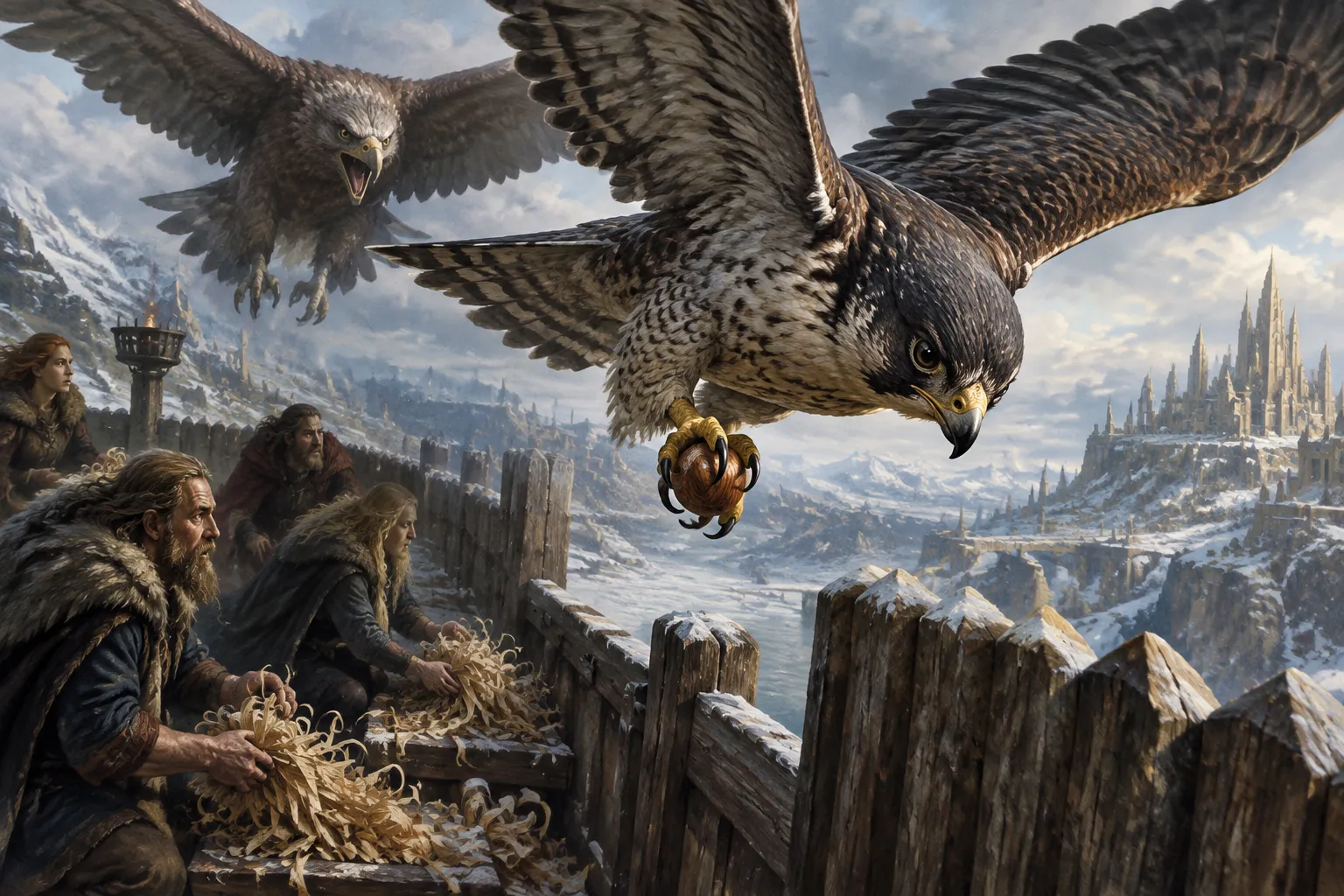
Loki flies north into Jotunheim and reaches Thjazi’s home while the giant is out at sea. He changes Idunn into the likeness of a nut, takes her in his claws and flies away. The extraordinary transformation solves a practical storytelling problem: a falcon can carry a nut where it could not carry a person. The prose gives the event, not a ritual procedure or a detailed theory of how the change works.
Readers interested in the broader motif can turn to this site’s discussion of shapeshifting and seidr, while keeping a boundary clear: this episode does not itself identify Loki’s transformation of Idunn as seidr.
Thjazi returns, discovers her absence and pursues in eagle form. As the birds approach Asgard, the gods pile wood shavings beside the wall. Loki drops inside; they ignite the shavings, and the pursuing eagle’s feathers catch fire. Unable to fly farther, Thjazi is killed within the gates. The pursuit and fire trap make the rescue a collective achievement: Loki retrieves Idunn, Freyja enables his flight, and the waiting gods stop the pursuer.
4. A poem behind the prose
The Prose Edda is a medieval Icelandic work associated with Snorri Sturluson and assembled, at least in substantial part, in the thirteenth century. Its exact authorship and development are not simple questions. Joseph S. Hopkins’s survey of English translations explains both these uncertainties and the structure of Skáldskaparmál: narrative dialogue leads into poetic terminology and quotations from skaldic verse.
Among those quotations is Haustlöng, attributed to the Norwegian poet Þjóðólfr of Hvinir. It presents mythological scenes as decoration on a shield received from Thorleif. The Old Norse text published from Finnur Jónsson’s edition places the Idunn adventure in stanzas 1–13; the surviving sequence then turns to Thor’s encounter with Hrungnir. This is a literary description of a shield, not evidence that we possess the shield itself.
The poem is not an anonymous Eddic lay simply because Snorri quotes it. It belongs to the skaldic material incorporated into his work. Its compressed descriptions assume familiarity with gods, giants and their relationships. The prose tells an accessible sequence of actions; the verse rewards an audience able to recognize characters through indirect names.
There is also a useful warning about translations. In stanza 9, the Old Norse text contains ellilyf ása, an expression concerning the gods’ remedy against age. Anderson renders the surrounding passage with an explicit reference to Idunn keeping youth-preserving apples. Readers should not treat every explanatory word in that historical English rendering as a separately stated detail of the Old Norse stanza. The prose’s clear apple narrative and the poem’s compressed wording need to remain distinguishable.
5. What the return restores—and what it leaves unresolved
Idunn’s recovery closes the immediate crisis, but Thjazi’s death creates another. His daughter Skaði comes armed to Asgard to demand redress. In the prose sequel concerning Skaði, the gods negotiate compensation rather than treating the killing as an event without consequences. Saving their own household has produced a claim from another.
The narrative gives us less access to Idunn’s perspective than a modern reader might wish. It tells us how she is deceived, seized and retrieved, but does not supply her thoughts about Loki afterward. Inventing forgiveness, revenge or a willing relationship with Thjazi would fill that silence with a new story rather than recover the medieval one.
What survives is powerful enough without those additions. The gods’ youth depends on the continued presence of someone they cannot replace. Loki’s cleverness both destroys and restores that security, while the community must act together to complete the rescue. Read in this way, Idunn’s abduction is not merely an adventure about magical fruit. It is a story in which the most formidable inhabitants of Asgard discover how vulnerable they become when the person who sustains them is gone.
Sources and further reading
- Snorri Sturluson, The Younger Edda, translated by Rasmus B. Anderson: the passages on Idunn in Gylfaginning, the abduction and rescue, and the translated Haustlöng excerpt. Historical translation; its explanatory wording requires care.
- Haustlöng, Old Norse text: reproduced from Finnur Jónsson’s Carmina Scaldica, 1929.
- Joseph S. Hopkins, Edda to English: a specialist guide to the Prose Edda’s structure and English translations, including their differences in coverage.


Pingback: Why Skadi Chose a Husband by His Feet - Norse Mythology
Pingback: Why Fenrir Demanded Týr’s Hand - Norse Mythology